Ficheiro:QuantumHarmonicOscillatorAnimation.gif
Saltar á navegación
Saltar á procura
Non se pode ver nunha resolución meirande.
QuantumHarmonicOscillatorAnimation.gif (300 × 373 píxeles; tamaño do ficheiro: 759 kB; tipo MIME: image/gif, en bucle, 97 fotogramas)

Resumo
| Descrición |
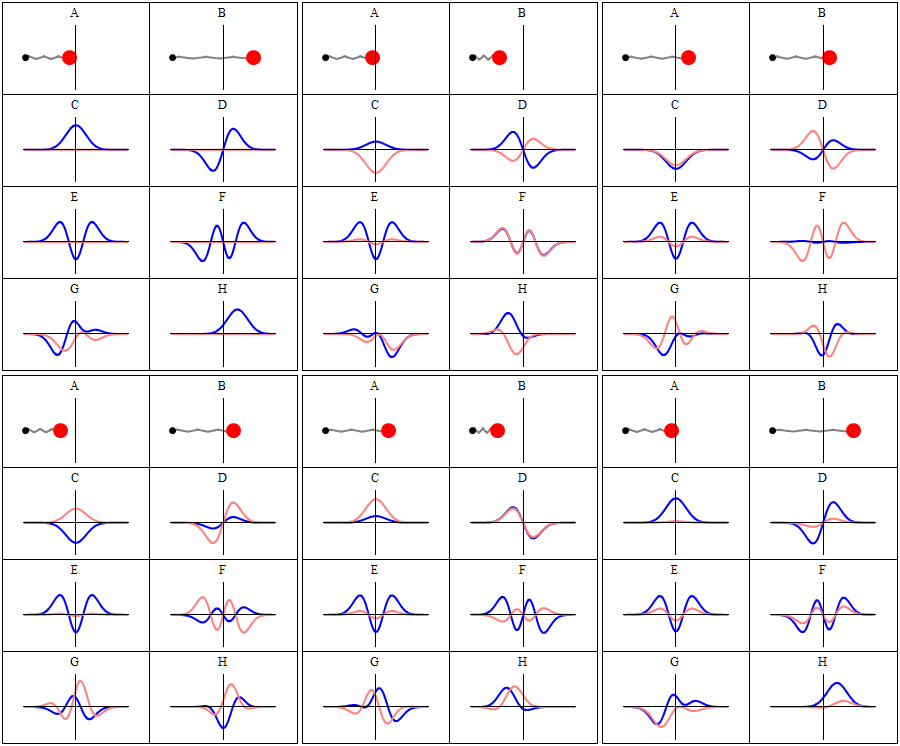
English: A harmonic oscillator in classical mechanics (A-B) and quantum mechanics (C-H). In (A-B), a ball, attached to a spring (gray line), oscillates back and forth. In (C-H), wavefunction solutions to the Time-Dependent Schrödinger Equation are shown for the same potential. The horizontal axis is position, the vertical axis is the real part (blue) or imaginary part (red) of the wavefunction. (C,D,E,F) are stationary states (energy eigenstates), which come from solutions to the Time-Independent Schrodinger Equation. (G-H) are non-stationary states, solutions to the Time-Dependent but not Time-Independent Schrödinger Equation. (G) is a randomly-generated superposition of the four states (E-F). H is a "coherent state" ("Glauber state") which somewhat resembles the classical state B.
العربية: مذبذب توافقي في الميكانيكا الكلاسيكية (A-B) وميكانيكا الكم (C-H). في (A-B)، كرة متصلة بنابض (خط رمادي)، تتأرجح ذهابًا وإيابًا. في (C-H)، يعرض حلول الدالة الموجية لمعادلة شرودنغر المعتمدة على الوقت لنفس الإمكانات. المحور الأفقي هو الموضع، والمحور العمودي هو الجزء الحقيقي (الأزرق) أو الجزء التخيلي (الأحمر) من دالة الموجة. (C ،D ،E ،F) هي حالات ثابتة (حالات الطاقة الذاتية)، والتي تأتي من حلول معادلة شرودنغر المستقلة عن الزمن. (G-H) هي حالات غير ثابتة، وهي حلول لمعادلة شرودنغر التي تعتمد على الوقت ولكنها ليست مستقلة عن الوقت. (G) هو تراكب أنشىء عشوائيًا للحالات الأربع (E-F). H هي "حالة متماسكة" ("حالة جلوبر") تشبه إلى حد ما الحالة الكلاسيكية B. |
| Data | |
| Orixe | Obra propia |
| Autoría | Sbyrnes321 |
(* Source code written in Mathematica 6.0 by Steve Byrnes, Feb. 2011. This source code is public domain. *)
(* Shows classical and quantum trajectory animations for a harmonic potential. Assume m=w=hbar=1. *)
ClearAll["Global`*"]
(*** Wavefunctions of the energy eigenstates ***)
psi[n_, x_] := (2^n*n!)^(-1/2)*Pi^(-1/4)*Exp[-x^2/2]*HermiteH[n, x];
energy[n_] := n + 1/2;
psit[n_, x_, t_] := psi[n, x] Exp[-I*energy[n]*t];
(*** A random time-dependent state ***)
SeedRandom[1];
CoefList = Table[Random[]*Exp[2 Pi I Random[]], {n, 0, 4}];
CoefList = CoefList/Norm[CoefList];
Randpsi[x_, t_] := Sum[CoefList[[n + 1]]*psit[n, x, t], {n, 0, 4}];
(*** A coherent state (or "Glauber state") ***)
CoherentState[b_, x_, t_] := Exp[-Abs[b]^2/2] Sum[b^n*(n!)^(-1/2)*psit[n, x, t], {n, 0, 15}];
(*** Make the classical plots...a red ball anchored to the origin by a gray spring. ***)
classical1[t_, max_] := ListPlot[{{max Cos[t], 0}}, PlotStyle -> Directive[Red, AbsolutePointSize[15]]];
zigzag[x_] := Abs[(x + 0.25) - Round[x + 0.25]] - .25;
spring[x_, left_, right_] := (.9 zigzag[3 (x - left)/(right - left)])/(1 + Abs[right - left]);
classical2[t_, max_] := Plot[spring[x, -5, max Cos[t]], {x, -5, max Cos[t]}, PlotStyle -> Directive[Gray, Thick]];
classical3 = ListPlot[{{-5, 0}}, PlotStyle -> Directive[Black, AbsolutePointSize[7]]];
classical[t_, max_, label_] := Show[classical2[t, max], classical1[t, max], classical3,
   PlotRange -> {{-5, 5}, {-1, 1}}, Ticks -> None, Axes -> {False, True}, PlotLabel -> label, AxesOrigin -> {0, 0}];
(*** Put all the plots together ***)
SetOptions[Plot, {PlotRange -> {-1, 1}, Ticks -> None, PlotStyle -> {Directive[Thick, Blue], Directive[Thick, Pink]}}];
MakeFrame[t_] := GraphicsGrid[
   {{classical[t + 2, 1.5, "A"], classical[t, 3, "B"]},
    {Plot[{Re[psit[0, x, t]], Im[psit[0, x, t]]}, {x, -5, 5}, PlotLabel -> "C"],
     Plot[{Re[psit[1, x, t]], Im[psit[1, x, t]]}, {x, -5, 5}, PlotLabel -> "D"]},
    {Plot[{Re[psit[2, x, t]], Im[psit[2, x, t]]}, {x, -5, 5}, PlotLabel -> "E"],
     Plot[{Re[psit[3, x, t]], Im[psit[3, x, t]]}, {x, -5, 5}, PlotLabel -> "F"]},
    {Plot[{Re[Randpsi[x, t]], Im[Randpsi[x, t]]}, {x, -5, 5}, PlotLabel -> "G"],
     Plot[{Re[CoherentState[1, x, t]], Im[CoherentState[1, x, t]]}, {x, -5, 5}, PlotLabel -> "H"]}
    }, Frame -> All, ImageSize -> 300];
output = Table[MakeFrame[t], {t, 0, 4 Pi*96/97, 4 Pi/97}];
SetDirectory["C:\\Users\\Steve\\Desktop"]
Export["test.gif", output]
Licenza
Eu, como posuidor dos dereitos de autor desta obra, pola presente publícoa baixo a seguinte licenza:
 
|
Este ficheiro está dispoñible baixo a licenza Creative Commons CC0 1.0 de dedicación universal ao dominio público. |
| A persoa que asociou unha obra con este documento, deu a obra ao dominio público renunciando a todos os seus dereitos sobre ela en todo o mundo baixo as leis de dereitos de autor e relacionadas ou dereitos legais derivados que tiña sobre a obra, na medida permitida pola lei. Pode copiar, modificar, distribuír e empregar esta obra, mesmo para fins comerciais, sen necesidade dun permiso por parte do autor.
|
Historial do ficheiro
Prema nunha data/hora para ver o ficheiro tal e como estaba nese momento.
| Data/Hora | Miniatura | Dimensións | Usuario | Comentario | |
|---|---|---|---|---|---|
| actual | 2 de marzo de 2011 ás 10:16 | | 300 × 373 (759 kB) | wikimediacommons>Sbyrnes321 | Alter spring, to avoid the visual impression that the ball is rotating in a circle around the y-axis through the third dimension. |
Uso do ficheiro
A seguinte páxina usa este ficheiro:
