Ficheiro:Hubble sees a cosmic caterpillar.jpg


Resumo
| Descrición |
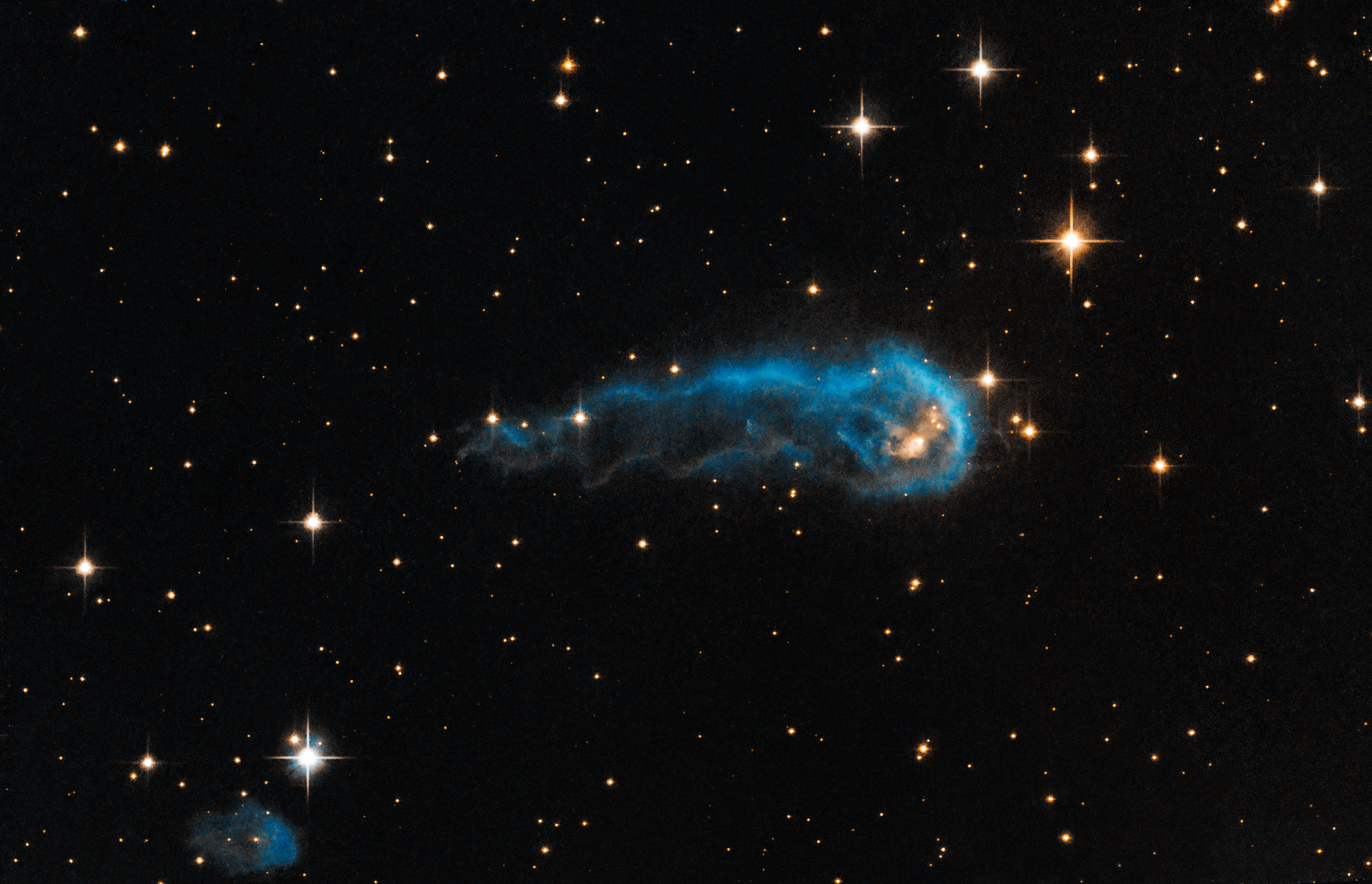
English: This light-year-long knot of interstellar gas and dust resembles a caterpillar on its way to a feast. But the meat of the story is not only what this cosmic caterpillar eats for lunch, but also what's eating it. Harsh winds from extremely bright stars are blasting ultraviolet radiation at this "wanna-be" star and sculpting the gas and dust into its long shape.
The culprits are 65 of the hottest, brightest known stars, classified as O-type stars, located 15 light-years away from the knot, towards the right edge of the image. These stars, along with 500 less bright, but still highly luminous, B-type stars make up what is called the Cygnus OB2 association. Collectively, the association is thought to have a mass more than 30 000 times that of our Sun. The caterpillar-shaped knot, called IRAS 20324+4057, is a protostar in a very early evolutionary stage. It is still in the process of collecting material from an envelope of gas surrounding it. However, that envelope is being eroded by the radiation from Cygnus OB2. Protostars in this region should eventually become young stars with final masses about one to ten times that of our Sun, but if the eroding radiation from the nearby bright stars destroys the gas envelope before the protostars finish collecting mass, their final masses may be reduced. Spectroscopic observations of the central star within IRAS 20324+4057 show that it is still collecting material quite heavily from its outer envelope, hoping to bulk up. Only time will tell if the formed star will be a "heavy-weight" or a "light-weight" with respect to its mass. This image of IRAS 20324+4057 is a composite of Hubble Advanced Camera for Surveys (ACS) data taken in green and infrared light in 2006, and ground-based hydrogen data from the Isaac Newton Telescope in 2003, as part of the IPHAS H-alpha survey. The object lies 4500 light-years away in the constellation of Cygnus (The Swan). |
| Data | |
| Orixe | http://www.spacetelescope.org/images/opo1335a/ |
| Autoría | NASA, ESA, the Hubble Heritage Team (STScI/AURA), and IPHAS |
| Outras versións |
.jpg) |
Licenza
  |
ESA/Hubble images, videos and web texts are released by the ESA under the Creative Commons Attribution 4.0 International license and may on a non-exclusive basis be reproduced without fee provided they are clearly and visibly credited. Detailed conditions are below; see the ESA copyright statement for full information. For images created by NASA or on the hubblesite.org website, or for ESA/Hubble images on the esahubble.org site before 2009, use the {{PD-Hubble}} tag.
Conditions:
Notes:
|
.jpg) |
- Vostede é libre de:
- compartir – copiar, distribuír e difundir a obra
- facer obras derivadas – adaptar a obra
- Baixo as seguintes condicións:
- recoñecemento – Debe indicar a debida atribución de autoría, fornecer unha ligazón á licenza e indicar se se realizaron cambios. Pode facer isto de calquera forma razoable, mais non nunha forma que indique que quen posúe a licenza apoia ou subscribe o seu uso da obra.
Historial do ficheiro
Prema nunha data/hora para ver o ficheiro tal e como estaba nese momento.
| Data/Hora | Miniatura | Dimensións | Usuario | Comentario | |
|---|---|---|---|---|---|
| actual | 17 de abril de 2019 ás 23:21 | | 2.938 × 1.892 (5,65 MB) | wikimediacommons>FriedrichKieferer | Better resolution and quality. |
Uso do ficheiro
A seguinte páxina usa este ficheiro:
